
Meet Jeremy: From Musician to Front-End Engineer at Qureight
As part of our team spotlight series we sat down with Jeremy Garner, one of our front-end engineers, to talk about his unconventional route into the role, what makes exceptional interfaces, and why building software for clinical trials is unlike anything else in terms of job satisfaction.
What did you do before joining Qureight?
That depends how far back you want to go! In a previous life, I was a musician. After that, I somewhat accidentally fell into software testing while working for the Royal Society for the Protection of Birds (RSPB), where I realised I was actually pretty good at it! I enjoyed working with technology, but I also knew I wanted to build things, not just test (and figure out how to / not to break!) them.
Testing turned out to be a great foundation. I worked with some excellent developers who helped me understand how everything worked ‘under the hood’. That gave me a pathway into engineering.
Before joining Qureight I was at a startup called Origami, building software for industrial battery operators supporting the green energy transition. I joined to help with test automation, but over time I moved fully into engineering and became a front-end-focused full-stack developer. That was where I officially made the leap.
What attracted you to front-end engineering?
Front end felt like the obvious place for me to land. As a test engineer, most of my time was spent thinking about user interfaces — how people interpret what they see, and what unexpected things they might try.
User interfaces became central to how I think about software because it’s how almost everyone interacts with it. As I moved into engineering, it was natural for me to focus there.
I like building software that real people actually use. Front-end engineering lets me take complex workflows or technical problems and present them in a way that feels intuitive. That challenge of turning complexity into clarity is what I enjoy most.
What separates average interfaces from exceptional ones?
An average interface lets you solve a problem, but it might feel confusing or frustrating. You might need help or feel like you’re fighting it to get something done.
An exceptional interface solves the same problem but in a way that feels simple and obvious. It gets out of your way. You never have to stop and think, “How do I do this?” The answer is right there, and that’s always what I’m aiming for.
What motivated you to join Qureight?
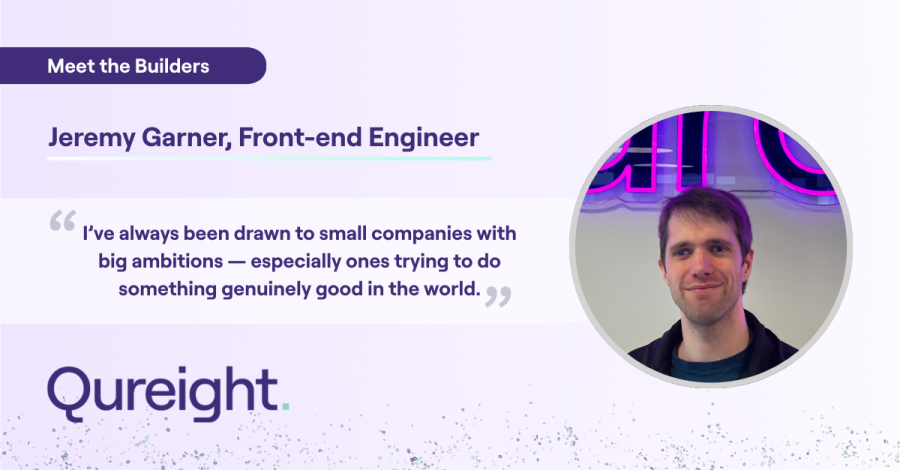
I’ve always been drawn to small companies with big ambitions — especially ones trying to do something genuinely good in the world. Financial success matters, of course, but I believe it should be a by-product of building something meaningful.
Qureight ticked those boxes, but the biggest factor was the people. During the interview process it quickly became clear that this was a knowledgeable, thoughtful team. Everyone, right up to the CEO, was personable, enthusiastic, and committed to what they were building, which made the decision easy.
What makes building interfaces for AI-powered clinical trials different?
The regulatory environment changes everything. In most SaaS (Software as a Service) products, you iterate constantly and that’s expected. In our world, making significant changes once a clinical trial has started carries more perceived risk and overhead because of ISO standards and GxP requirements.
Sometimes that means maintaining multiple versions of an interface for different customers, which adds complexity you don’t often see in traditional SaaS.
We’re also designing for different types of users across the globe, some of whom may not be highly technical. Add in tightly controlled IT environments and poor network connectivity, and you have to be extremely thoughtful about performance, optimisation, and clarity.
It’s a fascinating challenge.
What’s something you redesigned that made a big impact?
The imaging area of the platform stands out to me. The previous version worked, but it made too many assumptions about what users were trying to do. Those assumptions then became limiting as use cases evolved. It was possible to complete tasks, but it often felt cumbersome.
We redesigned it into a much more flexible query interface, removing those built-in assumptions and giving more control to the user. It dramatically improved its versatility and usefulness.
What excites you about the next few years?
When I joined, our main interface was largely internal. We’ve recently launched our first external-facing interface and what excites me most is building that out. The opportunity to creatively solve problems where there isn’t much prior art to follow, working directly with real users, and iterating based on real feedback, is a huge opportunity. I feel I’m helping to shape something meaningful from the ground up.
What advice would you give someone thinking about joining?
Come with ideas, but be ready to adapt and learn.
We’re a small team solving complex problems, and we won’t always get it right the first time. The ideal person here enjoys collaboration, is comfortable with ambiguity, and likes digging into challenging domains. You’ll also learn so much about the intricacies of medical imaging data, and the myriad challenges that presents in terms of its collection and processing.
If you’re curious, adaptable, and motivated by building something that genuinely makes a difference, you’ll love it here.