
Meet Richard: Building Partnerships for AI-Powered Clinical Trials
As part of our “Meet the Builders” series, we spoke with Richard Hoad, Director of Business Development, about his background in imaging CROs, what drives successful partnerships, and how Qureight is positioned in the market.
What did you do before joining Qureight?
I have been focused on supporting business development within the imaging CRO industry for many years. My expertise lies in developing partnerships with pharmaceutical and biotech companies, supporting clinical trials that required imaging expertise. I worked closely with sponsors and internal operational teams to scope studies, respond to Requests for Proposals (RFPs), and manage relationships throughout the lifecycle of a project. That experience gave me a strong understanding of what’s required, both operationally and scientifically, to successfully deliver imaging endpoints in clinical trials.
What attracted you to a career in business development?
Business development within this industry appealed to me because it sits at the intersection of science, strategy and relationships. I enjoy understanding a client’s challenge, identifying where our capabilities can genuinely add value, and then working with internal teams to deliver a solution.
It’s also a role where you’re constantly learning, about new science, emerging technologies and different therapeutic areas, while building long-term partnerships. That combination is what drew me to the field.
What motivated you to join Qureight?
Initially, it was my conversation with Jessica Payne, our Chief Commercial Officer, that sparked my interest. From the first discussion, I had a strong sense that the culture was something special. The interviews with the senior leadership team were some of the best I’ve experienced – very natural and open – which made it clear this was a collaborative environment.
As I learned more, what stood out was how clearly defined and scalable the commercial model is. The combination of strong product market fit, clear customer demand, and a platform that can scale across multiple diseases, made it a compelling opportunity to be part of.
What convinced you the company could operate credibly with global pharma and biotech partners?
Two things stood out: the strength of the science and the maturity of the delivery model.
From an operational perspective, it was clear that Qureight already has the infrastructure, workflows and quality frameworks needed to support complex global trials. That’s critical when working with large pharmaceutical sponsors.
Equally important is the consistency of the commercial approach. The fact that recent opportunities have converted at a high rate reflects not just strong technology, but a clear understanding of how sponsors evaluate and adopt new endpoints. That combination gives real confidence in Qureight’s credibility.
What does a typical day look like for a BD Director at Qureight?
A typical day is quite varied, balancing external engagement with internal coordination.
Externally, I spend time speaking with prospective and existing clients – from introductory conversations through to detailed discussions around study design and endpoints. Internally, there’s close collaboration with clinical operations to scope projects, assess feasibility and ensure we can deliver to the expected standard.
A key part of the role is also maintaining and developing the pipeline, identifying new opportunities and building on existing relationships. What makes it interesting is that we’re not selling a one-off service. We’re working with a platform that can be applied across multiple studies and diseases, which makes the role much more strategic.
What is a project that felt like a major “win”?
One of the most rewarding ”wins” is when a sponsor specifically requests Qureight’s involvement based on our scientific reputation and prior experience. What makes those moments meaningful is that we’re often selected in place of providers that have been around for longer. It reflects confidence in both our technology and our delivery capability.
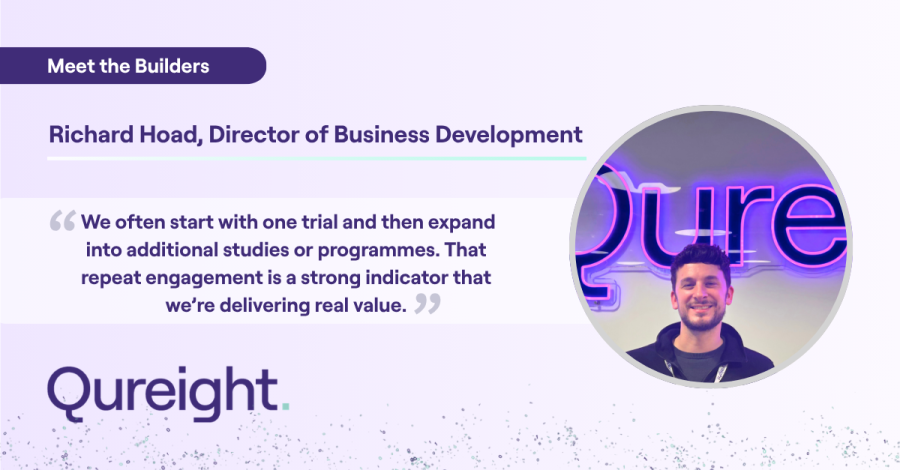
Speaking more broadly, success to me isn’t just about winning a single study. We often start with one trial and then expand into additional studies or programmes. That repeat engagement is a strong indicator that the Qureight team is delivering real value.
What excites you about Qureight’s position over the next few years?
First, the business has moved beyond being purely science-led to having a clear, repeatable commercial model. That creates a strong foundation for growth.
Second, the platform itself is highly scalable. We’re not building a new product for each disease, we’re extending a core system that already works. That makes expansion more efficient.
Finally, there’s clear demand. As sponsors look for more reliable and sensitive endpoints, particularly in areas like fibrosis and drug-induced lung disease, imaging is becoming increasingly important.
The technology and the market are aligned, which creates a significant opportunity for Qureight, which is a very exciting position to be in.
What advice would you give someone considering joining the commercial team?
I would absolutely encourage them to speak with us. Qureight is a great place to learn, not just about commercial strategy, but also about how an imaging CRO operates and how technologies like AI are applied in clinical research. There is a fantastic culture, and the team is very supportive. I’ve worked at several imaging CROs, but I haven’t felt as motivated or as excited to come to work as I have since joining Qureight.
What kind of commercial leader succeeds here?
Jessica Payne is a strong example. She is clearly passionate about what she does, and gives each member of the team the autonomy to take ownership of their work, but is always available to support when needed. Taking the time to talk through challenges and help everyone to understand the bigger picture are also important. That balance between independence and support creates an environment where people can develop quickly while still feeling backed by strong leadership.